Talk Less, Call RightEnhancing Role-Play LLM Agents with Automatic Prompt Optimization and Role Prompting
EMNLP 2025 Wordplay Workshop — Spotlight
1SCBX R&D 2SCB 10X R&D, SCBX Group, Thailand
API track Team HarryPeter
Task-oriented
dialogue
Choose and execute the right action.
Context-aware
dialogue
Stay grounded in the character and world.
One dialogue agent that combines both capabilities.
Can you tell me more about the Hunter’s Bow? How strong is it?
check_basic_info(
“Hunter’s Bow”)
The Hunter’s Bow is light and rapid-firing, with attack power well-suited for quick hunts.
- 01User query
- 02 · LLMFunction call
- 03Game API calls
- 04 · LLMDialogue
- 05Response
Abstract
This report investigates approaches for prompting a tool-augmented large language model (LLM) to act as a role-playing dialogue agent in the API track of the Commonsense Persona-grounded Dialogue Challenge (CPDC) 2025. In this setting, dialogue agents often produce overly long in-character responses (over-speaking) while failing to use tools effectively according to the persona (under-acting), such as generating function calls that do not exist or making unnecessary tool calls before answering.
We explore four prompting approaches to address these issues: basic role prompting, improved role prompting, automatic prompt optimization (APO), and rule-based role prompting. The rule-based role prompting (RRP) approach achieved the best performance through two techniques—character-card/scene-contract design and strict enforcement of function calling—leading to an overall score of 0.571, compared with the zero-shot baseline’s 0.519.
These findings show how explicit rules can improve the effectiveness and reliability of role-playing dialogue agents in this setting. The best-performing prompts and APO tool are available in the project repository.
Adapted from the abstract of arXiv v2.
Conversation and action in the same game world
A game’s non-player character needs to stay in character while selecting the right tools and arguments. CPDC 2025 tests both capabilities. Team HarryPeter participated in the API track using GPT-4o-mini, improving prompts for a shared underlying model.
Setting: paper §3 and the official challenge.
From role descriptions to explicit rules
The baseline uses separate function-planning and dialogue prompts. Four approaches build on that starting point:
Role
prompting
Improved role
prompting
Optimized
prompt
Rule-based role
prompting
- Basic role prompting. Add persona and scene information, and express tool outputs as narrative summaries.
- Improved role prompting. Refine instructions manually after examining invented functions, repeated calls, and tool misuse.
- Automatic prompt optimization. Try a zero-shot rewrite with Claude Sonnet 4 and an iterative ProTeGi feedback loop.
- Rule-based role prompting. Combine a Character-Card/Scene Contract (CSC) with Hard-Enforced Function Calling (HEF) instructions.
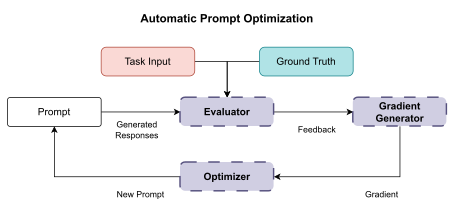
Rules that address recurring failures
Action first: make the relevant function call before producing the character’s response. Fewer calls: consolidate information needs with a composite tool where available. Exact schemas: use valid function names and parameter keys, and ask for clarification when the target is ambiguous.
The CSC listing specifies at most one call per turn. The HEF listing allows a hard cap of four while favoring one. These are distinct prompt constraints in the source; the page does not assume a single universal call limit.
The largest gain is in task execution
Rule-based role prompting achieves the highest overall and Task 1 scores among the reported variants. Improved role prompting retains the highest Task 2 score.
| Approach | Overall | Task 1 | Task 2 |
|---|---|---|---|
| Baseline | 0.519 | 0.442 | 0.597 |
| Basic role prompt | 0.523 | 0.451 | 0.595 |
| Improved role prompt | 0.533 | 0.448 | 0.617 |
| Optimized prompt (APO) | 0.538 | 0.464 | 0.613 |
| Rule-based role prompt | 0.571 | 0.531 | 0.611 |
Task 1 rises from 0.442 to 0.531: a gain of 0.089, or about 20.1% relative to the baseline. Task 2 rises from 0.597 to 0.611, but remains below the improved role prompt’s 0.617.
Partial correctness still exceeds exact accuracy
A separate local evaluation uses the starter kit’s training data as a validation set. These call-level metrics describe the best configuration; they are not the private-test leaderboard scores above.
| Metric | Exact | Partial |
|---|---|---|
| Function name accuracy | 0.308 | 0.714 |
| Argument accuracy | 0.231 | 0.643 |
The gap between partial credit and exact matches leaves substantial room to improve argument grounding. In particular, 71.4% partial function-name accuracy does not mean 71.4% fully correct calls.
Results and evaluation definitions: paper §5, Tables 1–2.
What changes in a conversation?
Two examples from the paper illustrate changes in tool selection. The traces below are reported examples, not a live agent demo.
One information request, fewer calls
A player asks about the Hunter’s Bow and its strength. The unconstrained agent requests general information and attack information separately.
Before
check_basic_info("Hunter’s Bow")
check_attack("Hunter’s Bow")
With rule-based prompting
check_basic_info("Hunter’s Bow")The composite information tool consolidates the request into one call.
A tool call before the reply
A player wants to join the Commercial Escort quest. The earlier agent replies with an acceptance message without calling a tool. The rule-based example first calls:
check_basic_info("Commercial Escort quest")This illustrates a change in call ordering. The shown trace is an information lookup; it does not by itself demonstrate that quest enrollment was executed.
Adapted from paper §5.3 and slide 11 of the supplied presentation.
Limitations
The study concerns the CPDC API-track setting with GPT-4o-mini. Its results do not establish that these constraints work equally well across models or open-ended environments. A strict one-call policy can underserve requests that need multiple tools, and exact argument accuracy remains low. Including the full dialogue history also adds latency; history-truncation strategies were not studied.
BibTeX
@misc{ruangtanusak2025talklesscallright,
  title = {Talk Less, Call Right: Enhancing Role-Play LLM Agents with Automatic Prompt Optimization and Role Prompting},
  author = {Saksorn Ruangtanusak and Pittawat Taveekitworachai and Kunat Pipatanakul},
  year = {2025},
  eprint = {2509.00482},
  archivePrefix = {arXiv},
  primaryClass = {cs.CL},
  doi = {10.48550/arXiv.2509.00482},
  url = {https://arxiv.org/abs/2509.00482}
}